Wednesday, August 24, 2011

Toys for Boys (and Girls)

During the dinner party our first night back from the countryside in Mongolia an adviser from Khan Bank asked me if I liked tanks.  Naturally, I said yes.  (What male wouldn't like a giant moving steel box with a cannon attached?)  She leaned in closer and said, "you know, there's a place about 60km outside the city where you can drive tanks."  She leaned in even closer and whispered, "I can set it up for you if you want."  Awesome.  Driving left-over Soviet tanks in Mongolia: what more could you ask for?  

As promised, Neal put us in contact with Bat who set everything up for us.  We've been wondering where some of the zeros in our bank account have run off to so we were hesitant to go through with it.  No need.  $135 to drive the tank five kilometers.  Five k in an ex-Soviet tank is, apparently, plenty of time to split between four people.  

So everything was set.  Mihi and the three of us left UB at 9am to make it to our appointment at the tank at 10:30am.  The Joshi's driver (provided by the bank) would take us so we wouldn't have to squeeze five people in the Niva.  He's also Mongolian and therefore wouldn't get lost on the drive.  Three hours later, after taking a handful of wrong turns including one needless foray over a mountain range we arrived at a gate with an armed guard.  We couldn't pass.  After ten or fifteen phone calls to a number of Mongolians we found out that the people who ran the tank compound were resting and that we should come back the next day.  Keep in mind that before leaving UB three hours previously we had talked with the same people to confirm our appointment.  But so it goes.  We had a quick lunch from the cooler that we had packed and headed back to the city.  We agreed, and later confirmed, that "resting" meant drinking.  At least they didn't let us near a tank when the only ones who knew how to operate it were drunk.  

The next day we made it to the compound at 10:30 on the dot.  The compound was situated in what looked like an abandoned military training ground.  There were pillboxes scattered in the hills and a barracks that had been neglected for at least the past two decades.  A big paramilitary-looking Mongolian greeted wearing combat boots and camouflage.  


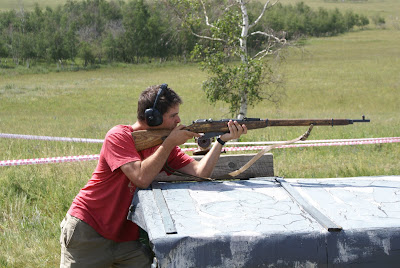
About 100 meters away was the tank (we assumed it was the tank because it was the only one in sight).  He escorted us toward it.  Then right past it.  We stopped at a shooting range where an array of WWII era Soviet weapons were displayed for us on a table.  We said, "No. Tank."  They said, "No tank."  Really?!?  No tank?  Then why did we come?  

After fifteen minutes of arguing back and forth with lots of hand gestures we gave up.  We decided to shoot a few of the guns and head back.  So we started pointing around the table choosing our favorites.  Then the big guy disappeared.  He reappeared holding a rocket propelled grenade (RPG) launcher.  Done deal.  Rockets were $100 a pop.  We each (including Mihi) took one.  


Shooting an RPG was a surreal experience.  Especially because it came as a complete surprise.  There was fifteen minute gap between the first moment any of us had seen an RPG-7 outside of movies and news programs covering Afghanistan and Iraq to Ezra hoisting the launcher onto his shoulder.  


When he pulled the trigger there was a loud whistling noise and a big bang.  


Ezra was aiming at a pile of tires about 150 meters away...


... and hit them dead on.  I don't think the Mongolians expected anyone to hit it.  After the smoke cleared and the tires had disappeared they ran up to Ezra cheering and throwing high-fives all around.  


I shot second.  I walked up to the line and they put the tube on my shoulder.  It took fifteen seconds for them to show me where to put my hands and to point downrange toward my target.  Then the instruction was over and they shoved the rocket down the tube.  I aimed, pulled the trigger, and hoped for the best.  There was almost no kick as the rocket left the tube, just the overwhelming whistling sound.  I missed high and left.  And my rocket malfunctioned (I think).  There was a dust cloud close to the tires then a second explosion 30 meters up the hill a full two seconds later.  I'm just glad the rocket didn't fall out of the tube and explode at my feet.  


Richard shot third and was close.  There was a moment when a huge dust cloud covered the tires and we thought he hit it.  It was an Independence Day moment when the U.S. launches a nuclear missile at the alien spacecraft over Huston.  A mushroom cloud engulfs the ship and the military command center rejoices.  The smoke clears and a transmission from the reconnaissance unit kills the celebration: "Negative.  Target remains."  That was us.  Cheering then, "the tires are still there!"  


Mihi shot last and didn't take off her purse.  Nuff said...

If I were to go back and choose between driving a tank and shooting an RPG I would take the RPG.  It was a blast (ha ha).  I now believe the stories we've heard about tourists shooting RPGs out of helicopters at cows in Cambodia.  The cow part isn't my cup of tea...


We're a little behind on our blog.  It's tough with sparse internet.  If you're in the mood check out our "progress" page for real-time updates from Facebook, Twitter, YouTube, etc.  

-Jack

Wednesday, August 17, 2011

Last Days at the Camp

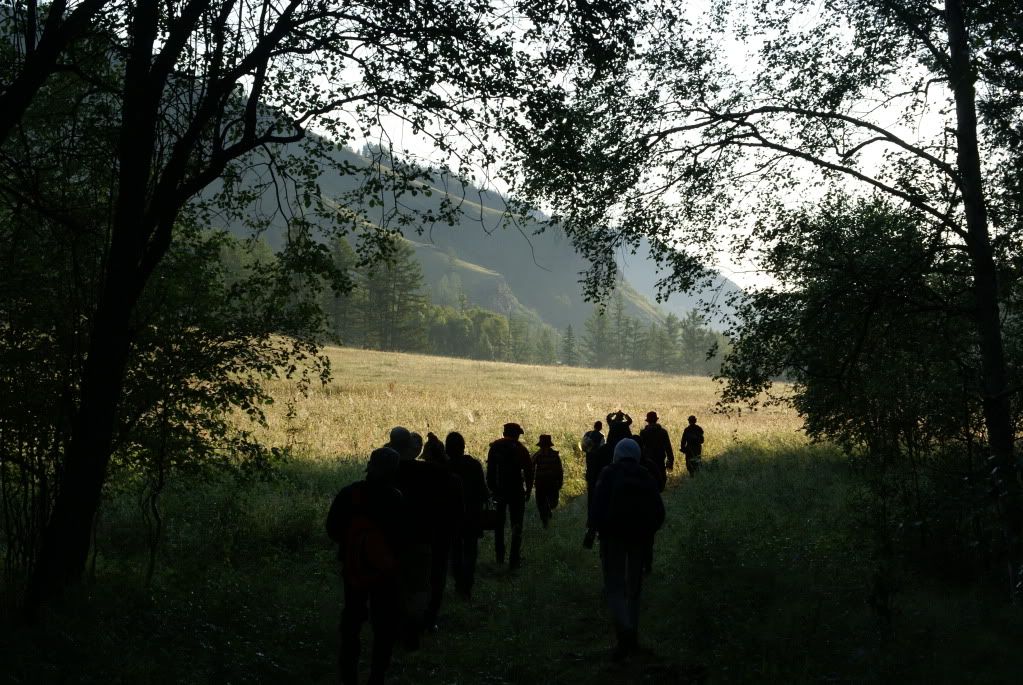
On the ninth day of camp we woke up a little after 6am.  The children were supposed to wake us up at 5am but due to a lack of alarm clocks we were woken up at 6:15 or so.  Of the handful of working clocks that I saw in the Mongolian countryside only three were within half an hour of the correct time.  But regardless of the actual time it felt like 5am.  After a hearty breakfast of beef noodle soup we each grabbed five dumplings and three biscuits and stuffed them in our bags.  At 6:59 we were on the road walking Northeast out of the camp just as the sun surfaced over the hills.


We were hiking to the cave where it is believed that Dayan Derkh lived after evading the Mongol army.  Dayan Derkh is a hero/legend/myth in Mongolian history.  He was a shaman who after stealing one of Chenggis Khaan's daughters fled along the river discarding garments as he rode to lighten his load.  The areas along the river where he fled (and where the monastery and camp are located) are named for the pieces of Dayan Derkh's clothing that were found at each.  There was a place area close to us called "shoe."  Anyway, after evading the Mongol army Dayan Derkh lived in a cave.  All the monks wanted to go to said cave and so we were.

The hike was slow at first.  Everyone followed the feet in front of them and didn't talk.  We were all still waking up.  The silence was broken by our first water crossing.  The trail took us straight into a stream that was about eighteen inches at it's deepest.  Two of the monks stripped off their shoes, rolled up their pants, and splashed across before anyone else knew what was happening.  The rest of us watched and waited.  I'm not sure what we were waiting for but it was clear that no one was excited to cross the river.  Two minutes of sitting on the bank imagining our wet feet on the other side and a monk popped out of the bushes.  He had disappeared without any of us noticing and aparently found something interesting upstream.  It was a tree that spanned the stream.


At the next water crossing we didn't bother looking for a tree and just walked across, jumping over the deeper parts.  By that point the sun was up and our feet dried quickly.  The rest of the hike was more or less uneventful.  Whenever we encountered a spiderweb blocking our path we went around it rather than walking through it.  I like to think that it was a monk "let live" type of thing but I have a feeling they were just scared of spiders.  Four hours in and we made it to the mountain.  Ezra and two of the monks were up ahead and gave the rest of us an idea of how far we'd have to go: all the way to the top.  It looked like a long way but in actuality it was only twenty minutes to the cave.


Finally a chance to relax...


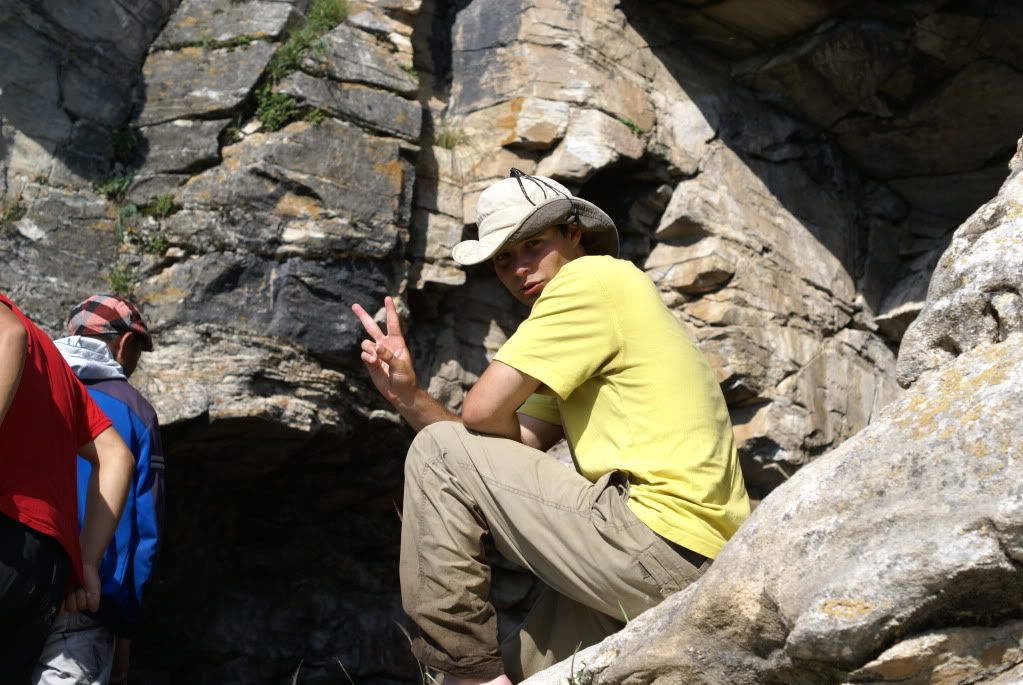
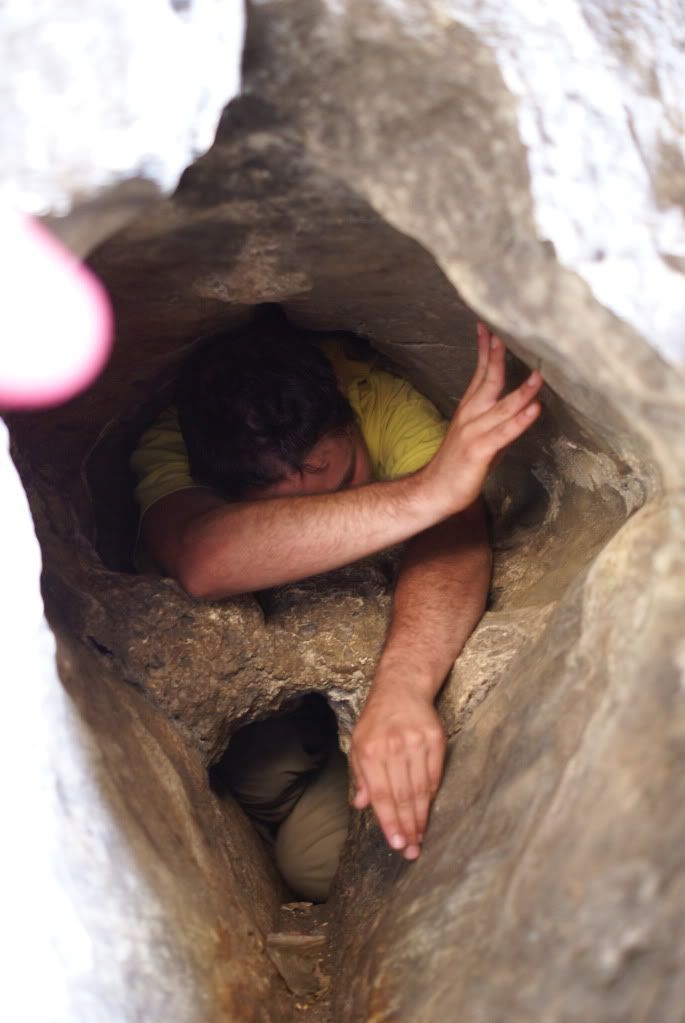
The cave itself was pretty amazing.  The first thing everyone did was strip off any loose clothing that they were wearing and climbed into the wishing hole.  It was a tight squeeze for some people *typing as I nudge Richard*.  Supposedly the more you've sinned the harder it is for you to get out of the hole.


It was very hard for Richard to get out.


I explored a little deeper into the cave with a few monks and found some ladders into small claustrophobia inducing passages and some bats.  Other than that the bowels of the cave just looked like a cave.


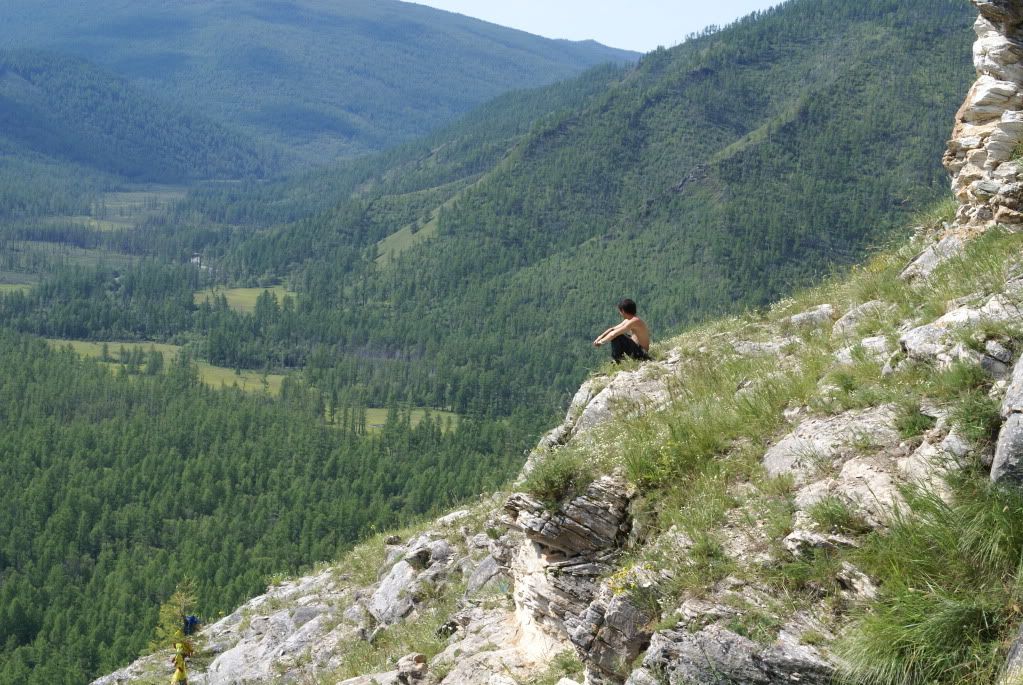
The monks chanted for half an hour while we ate our lunch outside the entrance.


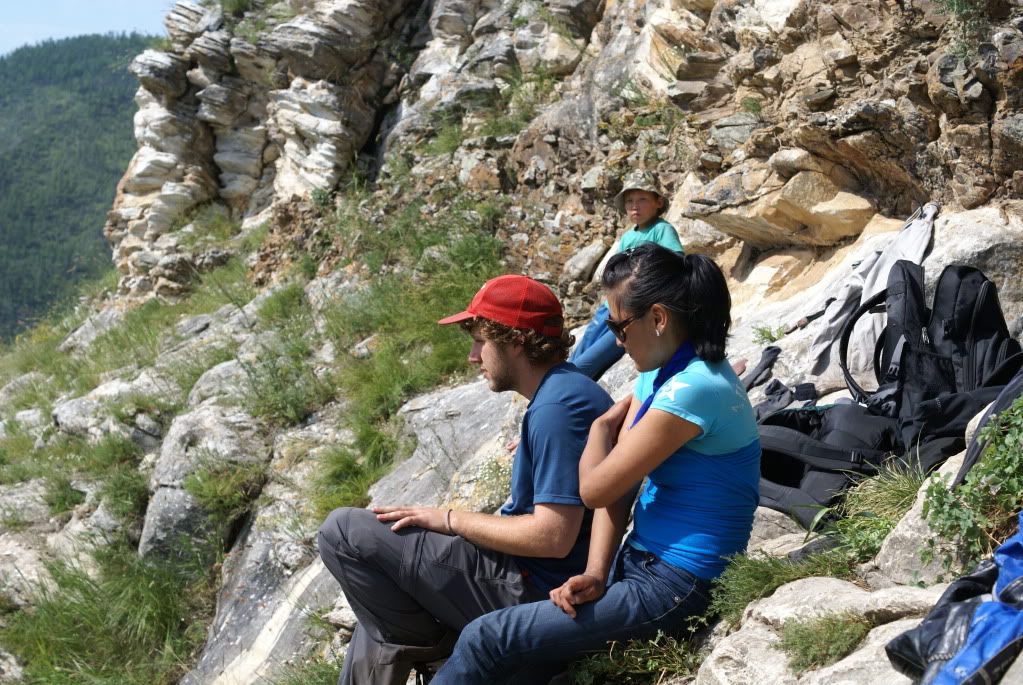
... and enjoyed the view.

The walk back was quick.  We all left together but Ezra, Amara, and I made it to the first water crossing first.  We decided to keep going and let everyone catch up.  Three hours later we were back at the camp.  Two hours after we arrived everyone else started filing in out of the woods.  Apparently there were some stragglers that the group waited for at each water crossing.  At one point Richard and the monk teacher Bayraa took a nap while they waited.  It was a long hike but well worth it.  Fifteen miles round trip.

The last few days at the monastery were uneventful and very relaxing.  We alternated between putting the finishing touches on the toilet and hanging out with the monks.  Leaving was a little more eventful.


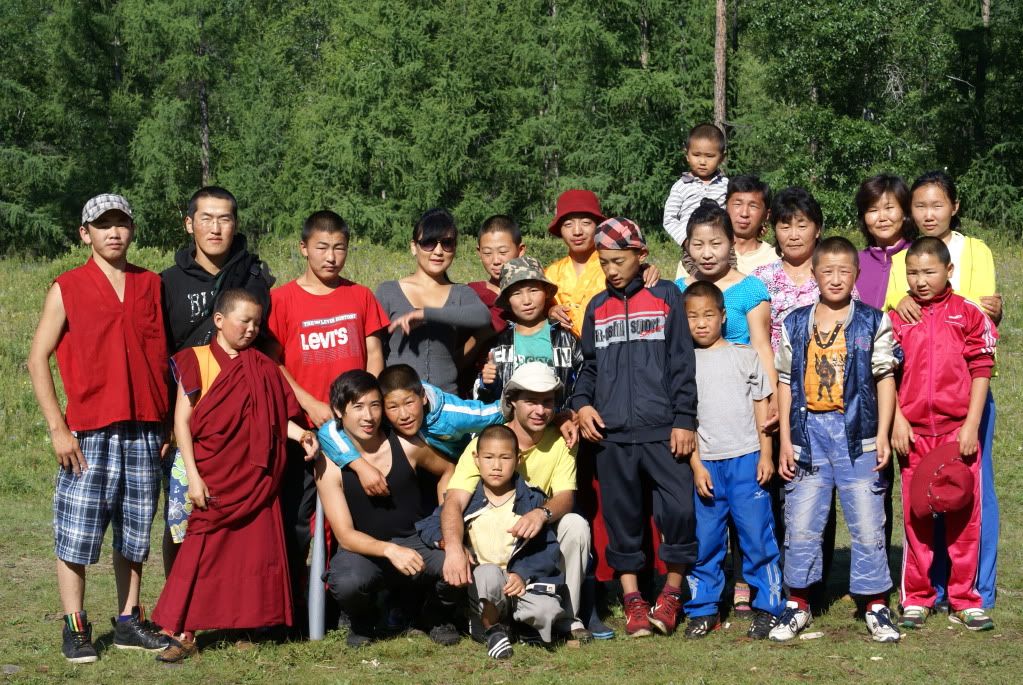
A quick group photo from our last day at the monastery.

Thursday morning, day thirteen, we woke up at eight and finished packing up our stuff.  After breakfast we found out that the bus coming to pick up the monks was no longer coming.  In the new plan most of the monks would pile into Chimga's van and four would come with us in the Niva to Erdenebulgan, about an hour drive.  Chimga's van would take half of the monks and us to the river to cross by boat.  The van would then return to pick up the other half and be towed across by a tractor.  We would then rendezvous at Bimba's house (where the Niva was hopefully waiting for us) and caravan to Erdenbulgan.

At 10am the van dropped about ten of us off at the river where we'd cross by boat.  As the van pulled away Bayraa talked to two Mongolians who were waiting to cross.  They told him that they had been waiting there for three hours.  The boatman was missing and the boat was on the other side of the river.  Mongolians are very wary of water and it's almost unheard of to swim.  Jokingly, Bayraa said that we (the Americans who can swim) should swim across and bring the boat back.  We said "okay" and went for it.  Bayraa, the monks, and the two locals watched intently as we waded in and started swimming.  They were all very skeptical that we'd (1) attempt to swim and (2) make it across without drowning.  Bayraa was especially hesitant to let us swim.


Had it not been for a six foot wide section of eight-foot deep water we could have waded all the way.  The river was below our waists for most of its width.


Needless to say we made it across and did not drown.  We ferried all the kids across and Bayraa and I returned for the two locals and their motorcycle.


An hour walk back to Bimba's house and we went straight for the Niva.  We held our breaths as I turned the key but there was no need.  The car started just fine.  Another hour and we spotted a silver something across the river and downstream.  Richard and I walked along the shore and confirmed our suspicions that it was Chimga's car.  What we didn't see was a tractor.  We kept walking and made it down to a rocky shore right across from Chimga's car.  There was a Russian jeep parked there.  Its owner was in the middle of the river stacking rocks about a foot high out of the water.  Richard and I assumed that the Russian jeep was going to make a go of it and if it made it across the mini van would then give it a shot.  The van would have some piece of mind knowing that an off-road jeep that sits eight inches higher than the van and was built to cross rivers could make it.  Nope!  The Toyota mini van loaded with ten people went first.  About a quarter of the way across the van slowed down to a crawl.  For twenty seconds or so Richard thought it had stopped.  But no, it persevered.  Halfway across the van turned downstream, following the markers the jeep driver had set out.  Then it turned back upstream and eventually (five minutes to cross a 100m river) made it to our bank.  Ten feet out of the water the van died.  It wouldn't start again.  I walked back to Bimba's and brought the rest of the monks and Ezra to the van.  We waited around for an hour and a half while Chimga's husband poked around in the engine bay.  No luck.  Ezra, Richard, and I left with our four monk passengers.

An easy drive back to Erdenebulgan.  Amara threw up, we delivered a note to call for a doctor for a woman with appendicitis in the countryside, we filled our gas tank and waved goodbye to Erdenebulgan and unmapped Mongolia.

The only notable thing that happened during the drive back to Ulaanbaatar was at 11pm on the first day of driving.  I was driving slowly through a town when a horse jumped in front of the car.  The Mongolian atop the horse was swaying a bit.  He spoke to us in Mongolian and seemed polite.  He hopped off the horse and came to the window.  He smelled like vodka and didn't seem polite up close.  He reached in grabbed my seatbelt with both hands then tried to open the door.  Ezra said go so I dumped the clutch and sped out of town.  He kicked the car but didn't follow us.

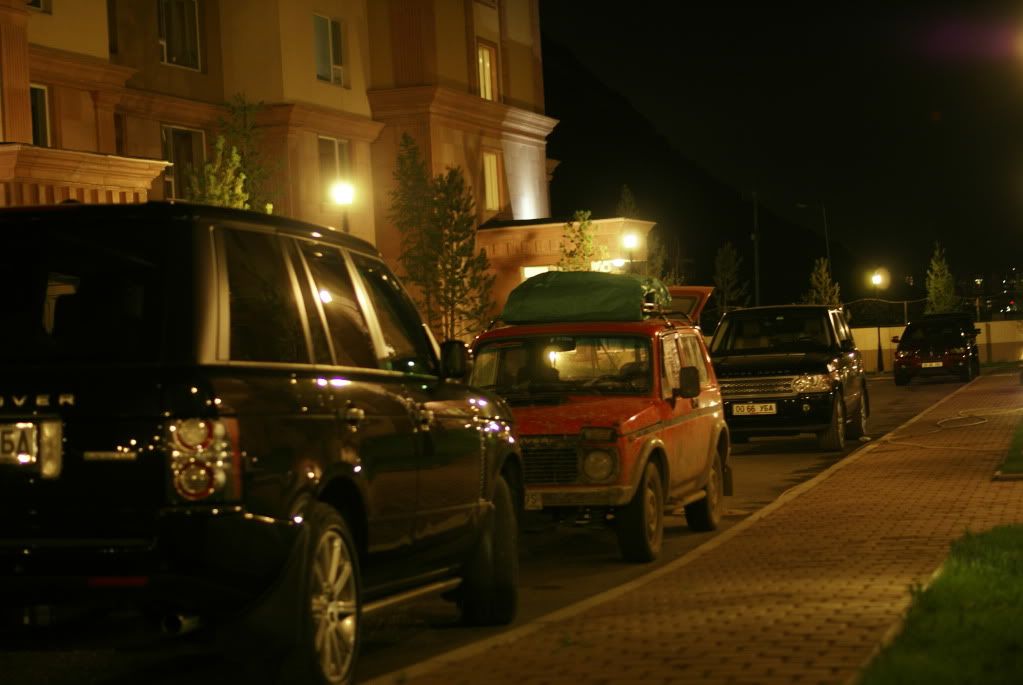
On the drive back to UB we called our college friend Mihi who we knew had just moved there with her family.  We told her that we were going to be staying in the city for a day or two and asked if she wanted to meet up.  She and her mother insisted that we stay with them.  We didn't refuse.  So after 36 hours of driving, sleeping in the car, and two weeks without a shower we pulled up to Mihi's apartment complex, parked between two identical black Range Rovers and walked into the middle of her parents' dinner party.  I sat next to the chief economic advisor for the UN in Mongolia and listened to stories about long hikes by helicopter with the German Ambassador.  I guess you could say it was a bit of a shift from the no-running-water countryside in which we'd spent the previous two weeks.


Our Niva parked between two identical black Range Rovers in front of the Joshi's building.  We fit right in, wouldn't you say?

Six days later and we're still here.  (Actually, I'm posting this four days after typing it... waiting for Ezra to post his blog to keep things chronological).    I've met some incredibly hospitable people on this trip and the Joshis are at the top of the list (up there with Misha's family).  We've been enjoying Japanese, Italian, Chinese, and home cooked Indian meals.  The past five days we've spent working on some logistics and touring Ulaanbaatar.  Bayraa, Chimga, and the rest of the monks made it back safely to UB safely.  Apparently their mini van started about thirty minutes after we left them by the side of the river.

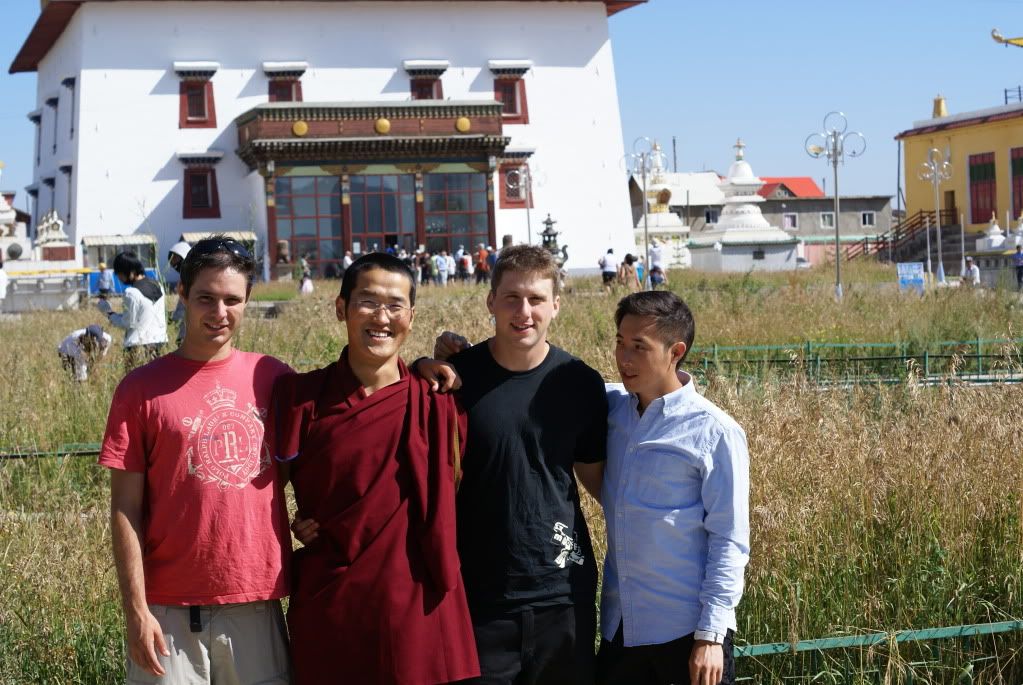
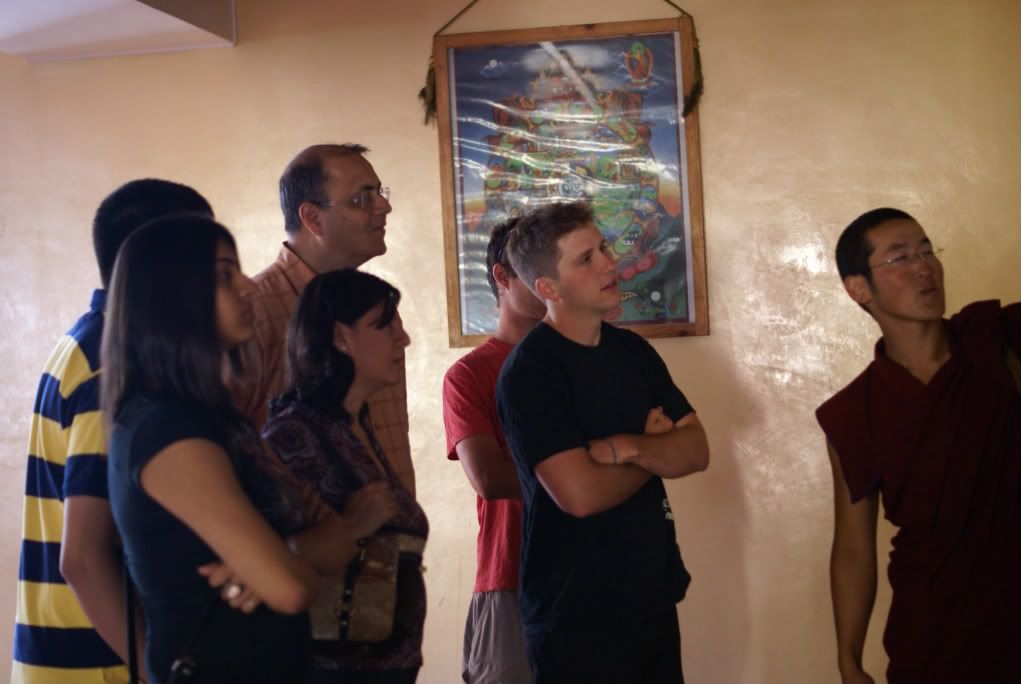
Bayraa spent a few days touring us around the city including the monastery where he teaches.  It's the biggest monastery (or maybe group of monasteries) in UB and we saw most of the monks who were at the camp.  Unfotunately, they couldn't speak to us because they were in the middle of chanting and other Buddhist ceremonial stuff.  It was nice to see them none the less.  It was also nice to get a smile or a wave from one of the monks while we were standing with all the other tourists.  When a monk puts down the shell that he's blowing into in the middle of a ceremony to wave and smile at you while all the other tourists watch in awe you feel pretty cool.


When he first showed up at the Joshi's apartment we barely recognized him in his "city" attire.  Bayraa isn't the monk I expected to meet.  After leaving the Joshi's apartment complex and merging into the middle of UB traffic (which is ridiculous) the first thing he did was honk at a car and flip off its driver.  (A quick note about UB traffic.  There are traffic signals at some intersections.  No one pays any attention to them.  There is absolutely no concept of right of way.  It took us 1.5 hours to make it 4 miles across the city on our way in to town.  Fifteen minutes of that was spent without moving an inch in the middle of an intersection.  We were boxed in by two cars to our right, oncoming traffic to our left, a perpendicular bus behind us and a perpendicular truck and trailer in front of us.  Nothing moved for the fifteen minutes while we sat there).


Left to right: Mihi's younger brother Aadi (hidden), Mihi, Mihi's parents Arvind and Neena, Rich, Ezra, and Bayraa (telling us the story of his monastery).


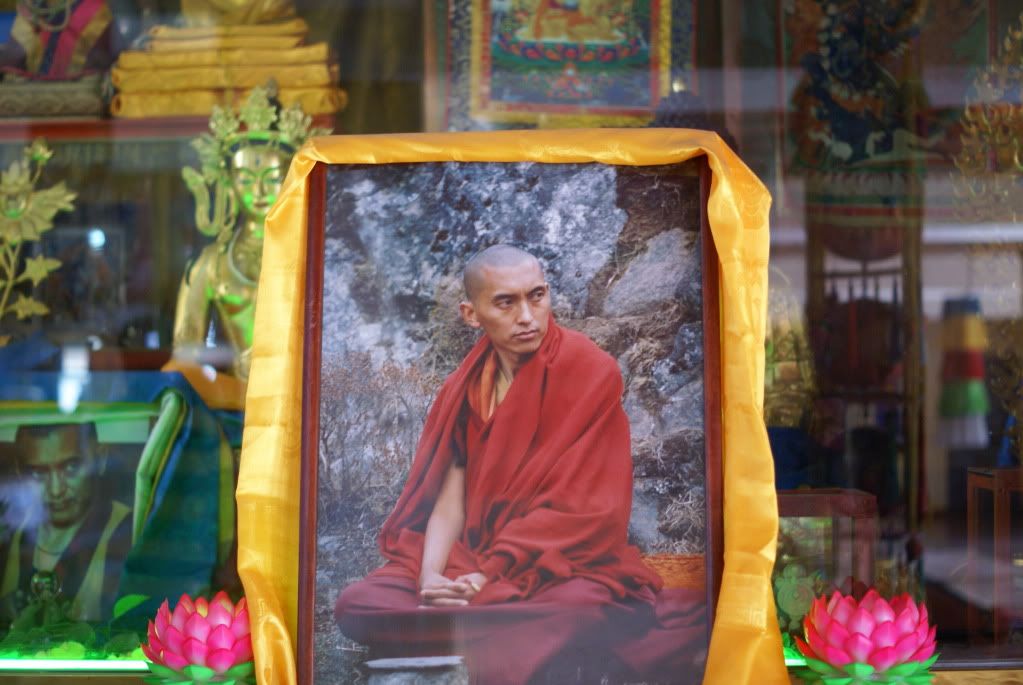
Bayraa's monastery was founded by this Indian monk and is still funded by a sister monastery in India.


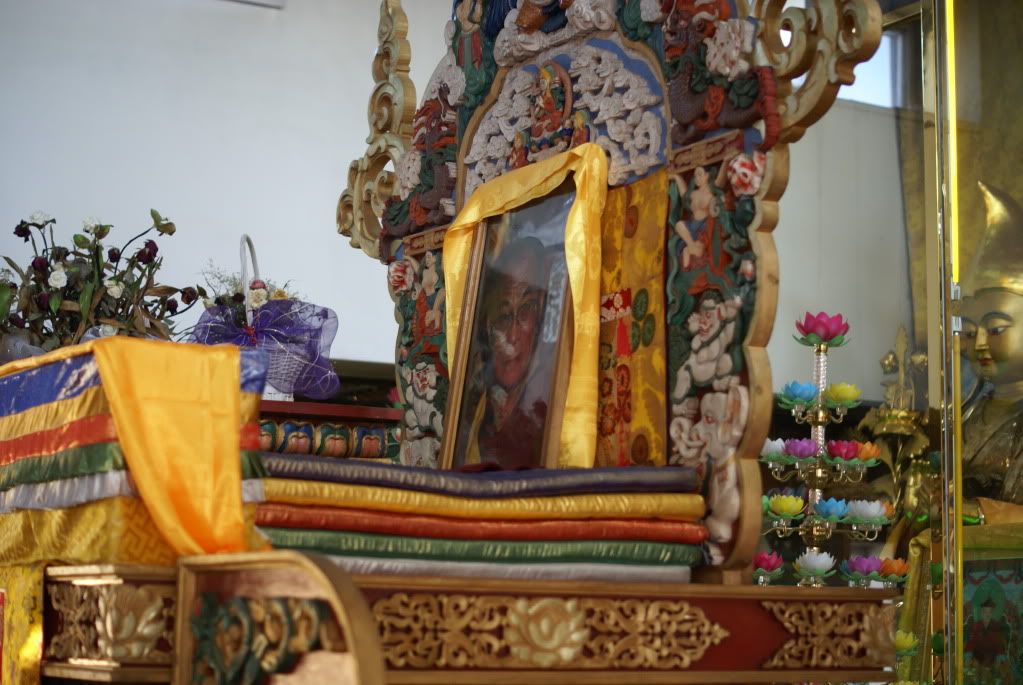
This chair has never been used as only the Dalai Lama can sit in it.

Tuesday night Chimga invited us over for dinner at their apartment.  The food was great.  We started with a potato salad - something that the Mongolians picked up from the Russians and eat for most meals.  Our main course was sliced steak, carrot salad, and rice.  Chimga also made a western green salad, something that she picked up while visiting the U.S.  Dinner was great and we were in high spirits when Chimga mentioned that the camp had been sold to a "corporation" in an under-the-table deal.  It was clear that this was weighing very heavily on her mind, and rightly so.  The camp was built and jointly owned by the Tributary Fund and the Tiamen Conservation Fund.  From what we gathered through Chimga someone at the Tiamen Conservation Fund was pressured into selling the camp to the son of the ex-president.  Now there's a good chance that camp will be turned into (and likely exploited as) a tourist destination.  Don't really know what to make of this.  It was our first firsthand look at corruption.  Everything that we put into the toilet - which pales in comparison to what TTF, TCF, and many of the local Mongolians have put into the camp - may be turned into a for-profit tourist destination.  And, no doubt, the type of tourism that the company (the name of which remains a mystery to those involved on the not for profit side) will be detrimental to the local economy and environment.  Chimga will fight to make sure that this will not happen.  The current plan is to encourage the locals to form a co-op to legally purchase the land from the government and not allow the corporation to setup camp.  This doesn't sound like a challenge but in reality it is for a number of cultural reasons.  So we hope for the best and we'll stay in contact with Chimga for updates and to offer our help if possible.  If anyone would like to contribute to the Tributary Fund please click here.  And if you would like to know anything else about TTF or their work in Mongolia you can check out their website or contact one of us and we'd be happy to talk with you about it.

On a slightly happier note, two days ago as the three of us were enjoying the paradise known as the Joshi's apartment and procrastinating on our blog posts I was wondering where the big story was in my "section."  I was envious of Richard and Ezra who had the first two sections and what I thought were better stories.  But then Thursday happened...  (Cue next post which may be a day or five away...)

- Jack

Arriving and Being at the Monastery


The following day we woke up to sounds of Mongolian singing coming from the radio inside Bimba’s house. The plan for the day was to check in with Chimga one more time and then get to the river crossing. Richard was told yet again to hop on the back of the motorcycle and headed off to finalize the plans. I was definitely worried about the car making the trip across the river. Even if it managed to get all the way across I was pretty sure the inside would be soaked along with everything inside it. Though if it did make it across and the only damage was some wet bags then we definitely would have lucked out. When Richard returned we got the news that we would no longer take the car across. The man with the tractor was not available anymore for whatever reason and the water was just way to high for it get across possibly even with a tractor pulling it. We didn’t want the car to get tipped by the current. To me this was good news. The car would stay at Bimba’s house for the two weeks we were gone covered by our tarp and we would take the boat across and not have to worry about the Niva for two weeks.


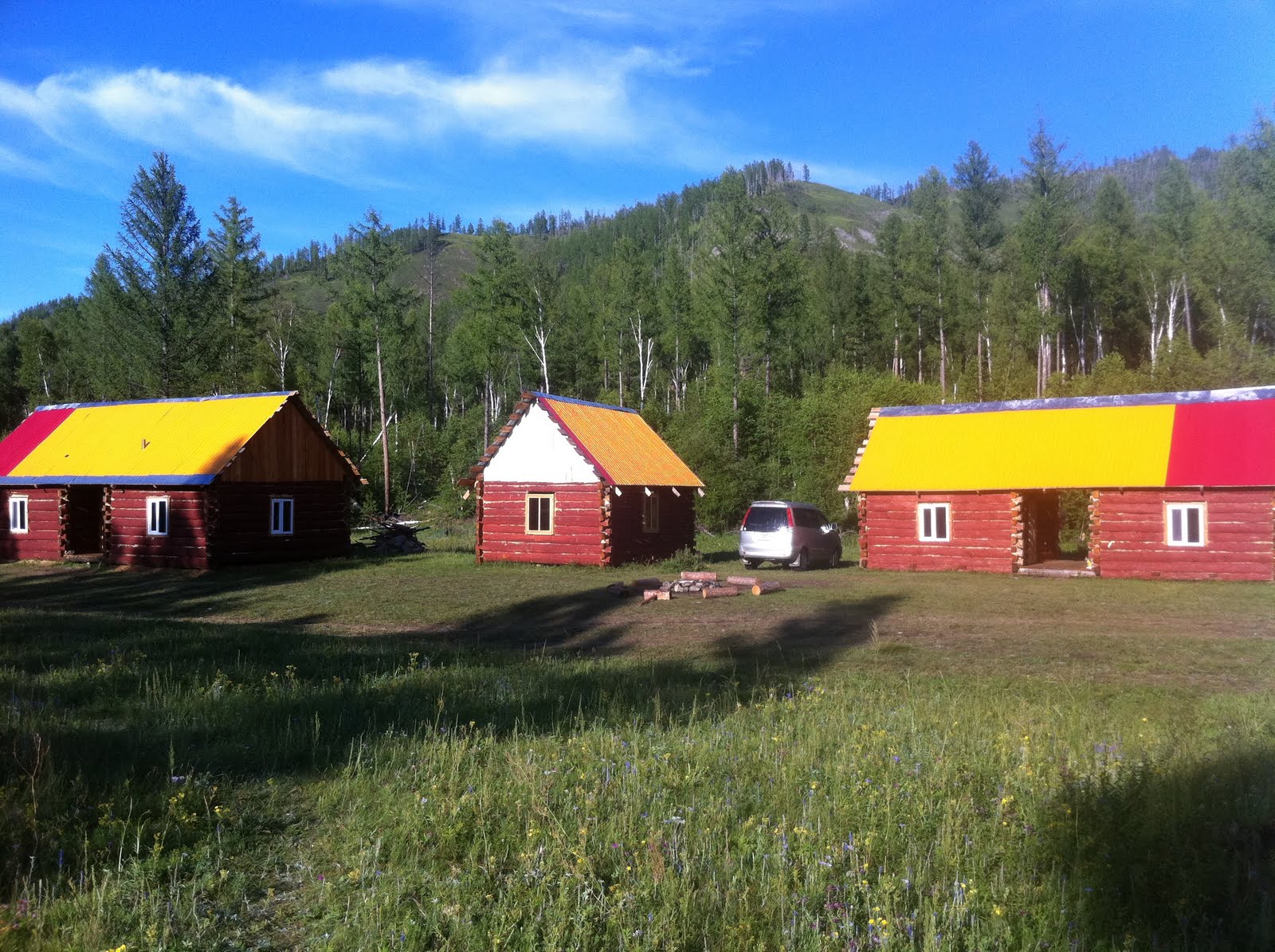
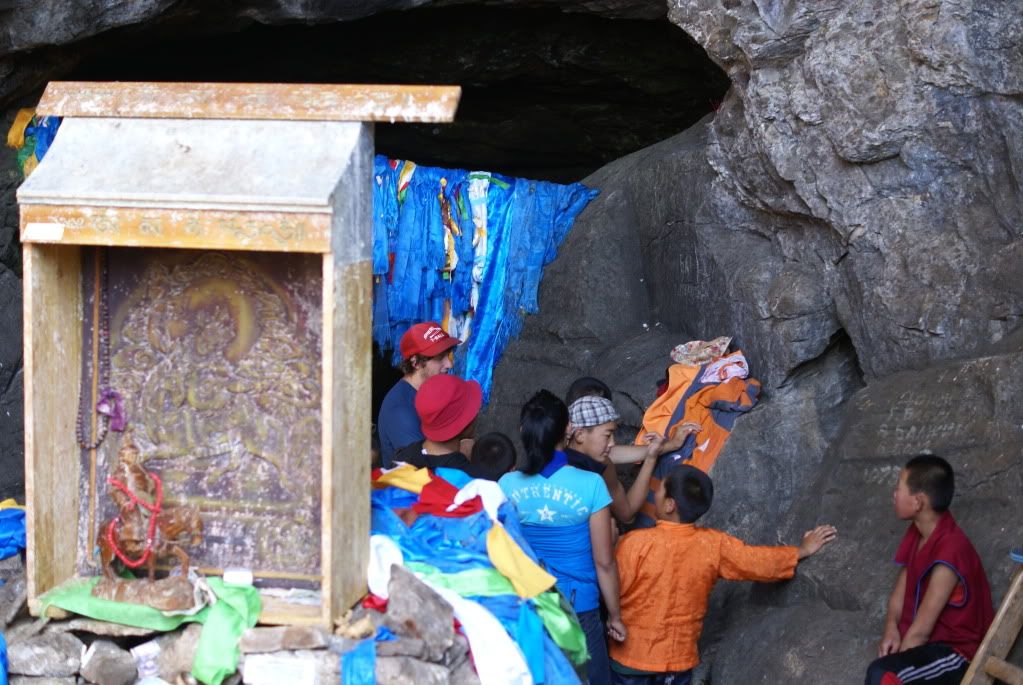
When we reached the river crossing we pulled out the gear we’d need for two weeks and jumped into the boat that took us across to Chimga, her family, and her van. After a 40-minute drive we had the monastery in sight. We hopped out of the van and were given a quick tour of the monastery. We learned that in 1938 the Soviets had come down and killed everyone that lived around the monastery. The monastery that we were inside was new and just built a couple years ago. The only remains from the community that existed before were two tall wooden poles from the original monastery. It was a sad story and made us want to help as much as we could.


We were then led back to the van and driven to the little house that served as the kitchen, dining area, and living area for the cooks. As we drove we went past children playing basketball on a court of hard mud. We were given tea and some soup. Everything seemed pretty relaxed and loosely organized. No one had really mentioned the eco-toilet that we were supposed to help build or what we would be doing with our time here. We were then taken back to a one-room building where we would be staying. I was under the impression that we would be camping for the two weeks in our tent so getting a place inside was a huge plus. In our room we had one bed, but since it was just flat boards of wood with the same mattresses you use on the ground there really wasn’t a difference between sleeping on the bed or the ground.


It was a slow start getting into the flow of things since it took almost two days for us to start on the toilet. So we spent our time playing games with the children, eating, sleeping, and sharing our medicine (which seemed to be in strong demand, Ibuprofen and what not).  But after using the toilet I could definitely understand the need to build a newer facility. For anyone that has been in a foreign country that uses mostly squatting toilets you know there is a certain technique that you got to master. For everyone it’s different. I don’t want to go into detail on my own style/swagger but I do want to talk about the flies and mosquitoes.  Depending on the time of day you will find yourself in different company. Early in the morning will be a mixture of both. From after breakfast until an hour or so before dinner you are chillin with the flies. Anytime you have to go afterward you are engulfed by the “shomoots” (mosquito in Mongolian I think).  This is definitely the worst time to go unless you don’t mind being bitten on your behind as well as other precious areas. I prefer to go during the day with the hundreds of flies swarming around. I developed this Zen technique that allowed me to become one with my surroundings. Using this newly developed technique I was able to enjoy my time in the outdoor John.

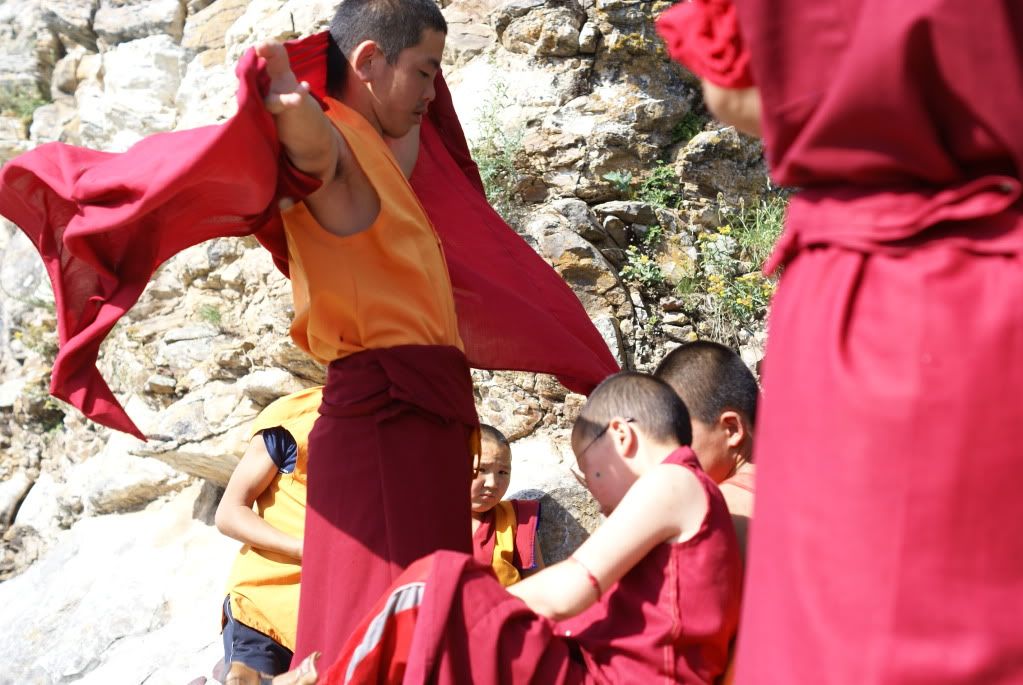
We were here at the monastery to help build an eco-toilet. We were working with The Tribuitary Fund that, headquartered in Bozeman, Montana, was run by Chimga in Mongolia. The Tributary Fund is all about connecting with local, religious, and scientific leaders to work on sustainable development and wildlife protection. The current project was to build an eco-toilet at the monastery. A side project for Chimga was teaching Ecology to the young monks at the summer camp that runs about two weeks each summer. The young monks came from different monasteries all around Mongolia.


Back to the toilet. The eco part was that instead of holes underneath the toilet there were buckets. I am not sure if even the Mongolians knew where yet, but the plan was to take the buckets to a composting site, which had not been built yet to my knowledge, and start composting to dispose of the waste. There were often times where we felt pretty useless during our time helping, mainly due to the language barrier. In those times we would just stand around, sometimes an hour or so at a time, and just wait for them to call one of our names to help. Our chores were basically cutting pieces of wood down to the right size, using the glue, making double-headed nails, carrying supplies, getting them whatever they needed, and the rare occasional chisel job. While we waited we played numerous “twenty questions” games. There were often times where we could definitely have helped more, maybe even taken on more of a direct role with a specific part of the toilet but it seemed better to just follow directions and be prepared to help as soon as possible.


Our daily life basically consisted of waking up around 9 and having breakfast with the monks. After breakfast the monks would get dressed in their robes and go to the monastery to do their chanting for about an hour. We would head down to the monastery as well and work on the toilet until around 1. At 1 we headed back for lunch and rested for 30 minutes to an hour. Usually around 2 or 3 we would head back down to the toilet to work again until around 7. In the beginning of the camp we would actually teach the monks English from 5-6 each evening. As the camp continued our English teaching became more sporadic as we got more work done on the toilet and the general schedule of camp became less organized. After dinner we would play games with the monks for almost two hours. We taught them how to play baseball and capture the flag. We spent a lot of time playing basketball as well. In those two weeks I probably got more rebounds than I had in my entire life.  In the evening we would have tea again and if it was a clear night make a fire and sit around singing songs and talking. The stars were absolutely beautiful. On clear nights you would be able to see the Milky Way.


In the morning our food was generally a milk and rice based soup in the morning. For lunch we would have two courses. It was usually soup with beef in it and then a second course of either homemade pasta (which Jack loved) or a dish with more beef slices, rice, and sliced carrots. Needless to say lunch became our favorite meal of the day. Dinner was usually another soup with beef and noodles in it. Occasionally we would be served dumplings at some meals as well. I thought the food was good but after two weeks of eating the same thing the food began to lose its charm.
Now here’s a good story. After about being there ten days we were eating lunch when Chimga’s husband (we never learned his name) approached me and asked if I wanted to drink some vodka. Now early in the week we had a little bit of vodka while working with them once we had finished the floor of the toilet. In Mongolia when you finish one wall of a house you stop and celebrate for three days. So I figured that we were going to head back to the toilet have a drink and continue working as we had done previously. I was wrong.  The six of us piled into the van. It was Jack, Richard, Chimga’s husband, Batbillik (the caretaker of the monastery), Sirarcher (the head monk), and myself. Sorry about misspelling their names but Mongolian words and names are both hard to remember and hard to pronounce. I still can’t say thank you correctly. Anyway, we headed out and as we neared the toilet we did not slow down. Instead, we continued down the path, over the hill, and through the trees until we came to a small house in a field. We got out of the car and entered the home where we received small cheese curd-like crackers and a cup of Mongolian vodka was passed around to one person at a time. The vodka was made from milk and tasted decent enough but as we drank more and more the taste definitely got worse. We finished the vodka we had received and hopped back in the van and were taken to another small home where the whole process was repeated again. After that we went to another home, drank, and took some vodka to go. Driving back we stopped to drink in the car three times, at the river once, and on top of a hill. By the time we made it back I was pretty sure we were all pretty gone, but I had faith that Chimga’s husband, who’d been driving this whole time, was intoxicated but doing ok. I found out later that I was wrong again. The whole afternoon was a lot of fun drinking with the three Mongolians. We arm-wrestled them, regular wrestled them, and Richard got shown police moves by chimga’s husband. It was the first vodka tour I’d ever been on and it was a lot of fun.


We got back to the monastery in time for dinner and it was clear everyone knew the type of afternoon we had. With stupid grins on our faces we chowed down the food. It was clear that Chimga was not happy but I think she was just doing the mom-worry. She told us her husband drinks maybe once a year so she was surprised. We lasted another hour or so before we all just went back to our cabin and fell asleep. The next morning we were supposed to go on a hike with the children but at the moment I was highly doubtful that I was going to get out of bed at the necessary time of 4 in the morning.


There are so many more wonderful photos and I cannot put them all right here so please check out our photobucket albums!


Pictures of the day out on the town.


More pictures of the toilet work.


-- Ezra

Thursday, August 11, 2011

Entering Mongolia


Although not a part of the original plan, I have enjoyed the experience that has come with the purchase of our Russian jeep as crazy as it sounds. It is definitely not the Subaru we wrecked, as many people have reminded us. Misha's father was one of the first to point out this fact. When we were searching for a car, when we were buying the car, when he was driving the car, and finally when we were all saying good bye at a gas station outside of Chita, he would always say in a thick Russian accent and sigh, "No Subaru." However, the Niva has succeeded at getting us to our destination and getting us back, which is all we ever asked for it to do.

It was going to be a two day trip to Ulan Ude to drop off our Russian friend Max. As our guide, he had informed us of an area between Chita and Ulan Ude where we must absolutely not camp because it was far to dangerous. The area was filled with gang activity and was unsafe for travelers, both Russian and foreign. We decided instead to stop outside this area next to a river in the late afternoon to set up camp and cook food. We then decided against this plan when two young men drove up in a motorcycle, circled us, and left without a word as we were unpacking. According to Max, we should leave quickly because they would come back later that night with some of their friends and beat us. With this new information we hastily packed up our gear and left the area. This change in plans caused us to drive through most of the night to cross through the danger zone. When we had made it through we finally stopped, exhausted, and fell asleep almost immediately along the side of the road in our tents. The next day we woke up early and drove the rest of the way to Ulan Ude to drop off Max. It was a quick good bye because we needed to get on the road however we hope to see him again when we go to Moscow. The trip would have been very different without him and the help he had given us.


The drive from Ulan Ude to the border of Mongolia and Russia was a short one relative to the longer drives we have done. When we reached the city where the crossing was located we had trouble finding it, which seems improbable because it is the border between two countries. We spent thirty minutes looking for a crossing which at times was close to only one hundred meters away from us. We were constantly asking for directions but it was difficult because all we could do to communicate was with hand gestures. When we finally reached the Russian border crossing we began our first of many mistakes. First problem was we tried to enter through the truck entrance rather than the car entrance. Then, we tried again, this time trying to enter through the bus entrance. Our third try brought success, and we were waved through to the next checkpoint. There, they checked our car, and our papers. When we gave the Russian exit visas that we purchased in Vladivostok with our Russian visas that we were told were invalid, the Russia Border Guards were very confused. Apparently, the original visas were still valid. They returned our Vladivostok exit visas unstamped and told us to continue on to the Mongolian side. Navigating the Mongolian customs was problematic as well because we skipped the customs building entirely. We only stopped before going clear to the actual border crossing when we asked a Mongolian customs official, who just happened to be walking outside, whether we were going the right way. She immediately turned us around and told us to park the car outside and enter a very large building to get our passports stamped. Ezra, because he was importing the car, spent a lot of time looking for stamps by different custom officials. These officials would often send him back the way he came for another stamp. In total, he walked back and forth between buildings eight times. Finally, when he claimed all of his stamps we went to the last checkpoint where the stamped paper was collected and the gate opened. We were finally, after so long and so much distance, in Mongolia.


The drive to Ulaanbaatar was long. The road is a single lane highway that runs through a number of small towns and communities. It was on this drive that we first experienced the domesticated animals that often cross the road, which perplexed me because I would often look around and there were so many other great locations for them to be in the great expanse that surrounded us. The animals seemed to know that they needed to get out of the way, but because we don't actually have a working car horn it is sometimes difficult to make them move with the urgency other drivers can. We finally entered the city and found the first decent looking hotel where we could rest and recuperate. It was called the Irish Pub Karaoke VIP Room Hotel which for a little less than $25 a night the three of us could stay in one room and have a hot shower, two queen sized beds, and cable TV.

The next day we left to meet our contact with the Tributary Fund and get the information necessary to meet with Chimga in the countryside. They gave us maps, phone contacts, and advice for traveling in the countryside. The man there, Baagi, was very amused it seemed that we would be trying to reach our destination with the Niva, but he didn't try to dissuade us so we took this as a good sign. The next morning we left to finally test the Niva on the dirt roads of Mongolia and, to be honest, I was slightly apprehensive.


We awoke at 6:30 AM packed up all of our stuff, loaded the Niva, and left Ulaanbaatar for the monastery. We followed the map very carefully and constantly asked questions at gas stations as to whether we were going in the right direction. During this drive, we found out a number of very interesting aspects about the Niva. For example, the Niva takes a break from driving from time to time. The first time this happened we had just left the pavement and in less than two miles of dirt roads the Niva's engine just died. We spent thirty outside the car, spit balling answers and tinkering with parts. We really didn't want to take anything apart because we no longer had the tools because of the accident, and we really didn't want to because the instructional manual we had was from British Niva enthusiasts. It was decided that one of us needed to go back to town to get, hopefully, a mechanic. I volunteered for the mission and waited for a car to pass by that could take me. The first car that came was to full because it had around eight people inside. The second car however only had seven so I hopped in and they dropped me off at the gas station of the town we just left. I got out, looked around, walked to where I saw a large group of Mongolian men relaxing outside. I didn't know what I was going to do to explain the predicament my friends and I were in. To my relief, there was someone there who could speak a little bit of English. When she explained what I needed, two Mongolian men pulled out a motorcycle, motioned for me to hop on the back, picked up a child of about five and put him on the handlebars and away we went. When we arrived back at the Niva, the two men hopped off, cleaned the spark plugs of dust, started the car and we were on our way. It was later, when the car broke down once again that we realized they hadn't actually done anything, they just came at the right time. The car overheats when it is in a low gear and a low speed for a long time. It happened again two hours later, and again another two hours later.


Now we have learned to wait for the car cool down. It gives us time to relax and take in the Mongolian countryside. We take pictures, stretch our legs, and walk around for a bit. It is just another little quirk we have learned about our new car. 


We camped the night on the side of mountain, once again waking up early for the drive. Almost every ger we saw we stopped to make sure we were going the correct direction. There are many, many dirt roads that weave in and out across the countryside and it is very easy to take the wrong one and get lost. We arrived in Erdenebulgan that afternoon and we wanted to continue to the river crossing but we were unable because we had to refill our gas tanks. The power in the town was out and nothing was working so we ended up being stuck for a few hours. A number of Mongolians were visiting the gas station periodically, waiting for gas just as we were. One such group were two interesting characters who took us to the river where we washed ourselves while they drank from a bottle of vodka. When we returned to the gas station I passed out in the back of the Niva while a dozen Mongolians started talking to Jack and Ezra*.


 (*Ezra here to fill in the gap). Back a the gas station Jack and I whipped out the map to show our motorcycle buddies. We were trying to figure out if there was another place on the way the river crossing where we could get gas. Through multiple hand gestures we thought we had confirmed that another place for gas lay ahead and the dudes would guide us there as well. We were about to leave with them when more people began to gather around and take turns studying our map. As time went on it became clear that we had not communicated clearly with the motorcycle guys, who by the way seemed to be getting more and more drunk. The more we tried to communicate with other people the more it seemed we should not trust the guys on the bike. Luckily, we met a more trustworthy face in the crowd when a woman who seemed to know, or at least know the name, Chimga  began helping us.  As the power came back on, we got our gas and I took her to a house where I was told I would find a workable phone to call someone we knew in Mongolia who could translate for us. After passing the phone back and forth with the woman I was told that she would guide us to the place we needed to go. After driving her to her home where she picked up a day bag and her son we were off.  -Ezra

She guided us to a home right next to the river that we needed to cross. The man who lived at the home, Bimba, pointed at me and pointed to the motorcycle he had just taken out from the back of his house. We thought he was getting ready to drive us across the river with his motorcycle and he was going to take us one by one. Instead he drove me for forty minutes up the river on a small dirt track. We crossed over swamps, plains, steep hills, and forests. Twice, he almost lost control of his bike while driving far to fast. After traveling through a forest with dense, tall grass, the trees broke and I saw across the river what looked like the top of a Monastery. We waited there for another thirty minutes until I saw walking up from the other side the figure of a woman, it was Chimga. Yelling across the river we then set a plan for the next day where we would have our Niva towed across the river by a tractor. She told me she was worried that our car would flip in the river however, because the current was very strong and our car was top heavy and very light. After our talk, Bimba drove me back to his house where Ezra and Jack were waiting. Bimba gave us an area to set up our tent where we fell asleep, so close to our final destination, wondering what would happen tomorrow.

-Richard